
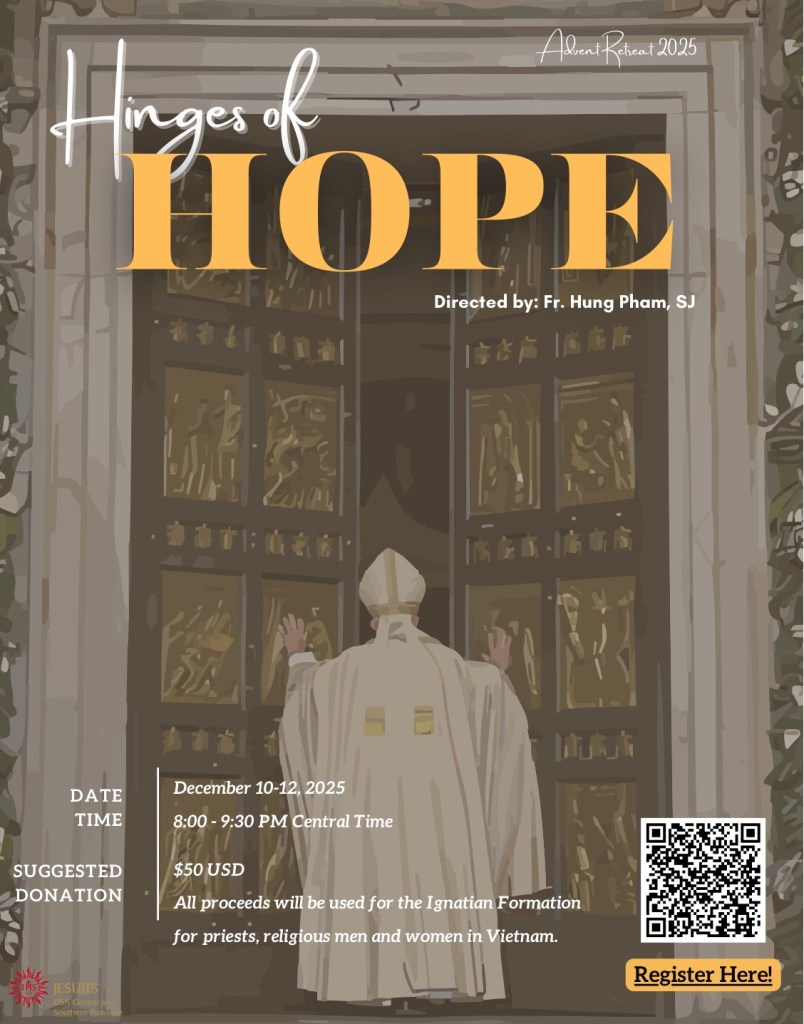
The season of Advent invites us into a sacred rhythm of waiting, expectation, and discovery. It is more than a countdown to Christmas-it is a time to pause, reflect, and rediscover the deeper meaning woven into these weeks of preparation. In that spirit, I’m delighted to share the Hinges of Hope Advent Retreat guided by Fr. Hung Pham, SJ. This retreat offers a space to gather with friends from across the globe, to breathe deeply, to ponder our deepest hopes, and to reflect on how the “doors” of our lives might open wider to grace, to love, and to one another. You’re warmly invited to register here for the ZOOM session and step into this journey of reflection.
As we begin Advent, I offer you the following meditation on Holy Doors, a journey through the door of Christ.
Journeying through the Door of Christ
Behold, I stand at the door and knock, says the Lord. If anyone hears my voice and opens the door to me, I will enter his house and dine with him/her, and s(he) with me (Rev. 3: 20)
Each day, we pass through numerous doors without being aware of the implication or transformation that awaits us on the other side.
There are many kinds of doors in our lives. In our homes, we walk through physical doors such as the bathroom door, kitchen door, dining room door, bedroom doors for our spouse and children, and the front door of the house. Outside of our homes and families, we often pass through doors like the office door, restaurant door, gym door, and even virtual doors like the laptop screen, and social media platform. In our spiritual life, we cross the sacred thresholds such as church door, door of a retreat house, or door of various space reserved for confession and/or for spiritual direction. Then there are doors of human emotions such as a handshake, a kiss, a hug, a smile, a steam of tears. All possess power to transform or deform.
Hidden behind those visible doors, more importantly, lie the invisible doors of the senses, the doors of our heart. In fact, opening the visible doors lead us to unlock the invisible spaces and vice versa. Ultimately, life boils down to the fundamental decision of choosing which doors to open and which ones to close. The choice of opening my heart to life’s possibilities or closing it in fears, electing to unchain our heart’s desires or bury them in trepidation, are indeed the matter of life and death.
To open or close this website, to text or not to text that message, to speak up or to keep silent, to join an organization or leave, to go for a walk or to sit at home playing online games. These decisions may seem trivial, but are all part of opening and closing doors that cultivate and determine my well-being and identity. Truly, decisions that are at times considered mundane, or made automatically, rarely require us to think twice, are what lay the foundation of the door to life, of adorning commitments and establishing the identity of a person in society.
What university and classes we choose to enroll can determine our entire career. A tap on a computer keyboard could either launch us into a journey of discovering new knowledge and understanding or lead us into the darkness of career terminating, even prison cells. Initiating a conversation to start a relationship could bring joy and happiness or destroy the relationships we have built, breaking commitments we have vowed. Not everything is meant to be opened. Wearing our heart on the sleeve often causes unnecessary pain and hurts. Playing it safe can isolate and alienate oneself from entering life-giving relationships with others. The excitement as well as the challenge remains in the wisdom of knowing when to open, when to close, and how. Thus, Vietnamese elders often teach their children to “Learn how and when to [open the mouth] to eat and/or to speak, how and when to wrap and/or to untie.”
In today’s Vietnamese culture, “door” is also a symbol of opportunity, accessibility and privilege. For example, a person would playfully say, “I really want to work at the embassy, yet I don’t have ‘door’ that would connect me to the proper channel”, or “I wish to meet Pope Leo XIV one day, but I am afraid that I won’t have a ‘door’ that would introduce me to the Holy Father and take me to see him!” While playful, these sentiments reflects the reality of how “door” could function as real power in people networking.
Whether open or closed, doors funtion only because of their hinges. These hinges – the quiet, hidden connection between a door and its frame, between what is mobile and what is stable – may seem small, yet they are what make the entire movement of a door possible. On the one hand, the hinges are tightly screwed to the wood. On the other hand, two hinges rotate around an axle generating the swing. As a result, doors can operate smoothly only when hinges are sturdy and well-oiled. Similarly, the function of the person’s heart and action are hinged upon the solid ground of faith and moral values while remain mobile and agile in integrating them into the rhythms of daily life with its surprising grace.
In the Church, DOOR serves as a central symbol of the Jubilee Year. Journeying through the Holy Doors of the four designated Basilicas means far more than the physical act of walking through, or posing to take a photo for posting purpose as proof that “I was there.” These doors embody a long history of saints’ and sinners’ discernment, transformation and renewal of faith. Passing through these Holy Doors speaks to a deep desire to open one’s heart so to be drawn ever so near to Jesus Christ and his way of being and living, the Emmanuel – God with us. Imprinted on these doors are examples of living faith which the Church invites us to imitate.
Entering the Holy Door of the Basilica of Saint Mary Major, we encounter Our Mother Mary – who knows how to open her heart saying “YES” to what is seemingly impossible to the human mind.
Stepping through the Holy Door of Saint Peter Basilica, we meet the Rock who knows how to unlock tears when recognizing his own brokenness, his humanity, while yearning to remain faithful to the end confessing, “Lord, you know everything. You know that I do love you.”
Journeying through the Holy Door of Saint Paul Outside the Walls Basilica, we face the “Apostle of the Gentiles” who has the audacity to be open and willing to go out to the frontier, meeting and “becoming all things to all people” for the sake of the Gospel.
Passing through the Holy Door of the Archbasilica of Saint John Lateran, we are greeted, on one side, by the “voice from the desert” of Saint John the Baptist continually pleading us to “prepare the way for the Lord.” On the other side, we are reminded of the words of Saint John the Evanglist insisting on Jesus is “the way, the truth, and the life.”
As in the lives of our Mother Mary and of the saints, so too in ours, we can only pass through those holy doors of faith because Christ has gone before us, paving the way. Though divine himself, he chose not to remain divine but to open the door of heaven to join us in our humanity. In humbly sharing in our humanity, Christ becomes “the DOOR” enabling and empowering us to share in his divinity. Furthermore, Jesus’ death and resurrection have broadened the space of sacred encounter between the divine and humanity, tearing apart what separated the sacred and the profane, extending it beyond the gate of hell.
Relying then on the power of Christ’s death and resurrection, let us follow the footsteps of Our Mother and of the saints to courageously and genersouly open our hearts to meet one another where one is. Let us to love and to share with each other genuinely and authentically, so as pilgrims in hope accompany each other in our journey to and through the Door of Christ.
Fr. Hung T. Pham, SJ, Bali – July 2025

 Smitten With Goodness